Pupil voice in Primary Art and Design

I often find myself responding to Qs from art subject leads via FB and emails, these questions are increasingly around how to evidence progression and how to ‘defend’ a particular approach to assessment… For example, a decision by a teacher not to use the general school marking system in sketchbooks (I myself do not write in children’s sketchbooks).

I am a big believer that gaining and collating feedback from the children forms an important part of the bigger picture and direction of your art provision, and any outside visitors should be interested to hear their perspective too. Here are some ways I have gathered pupil voice in the past:

A simple A4 question sheet to KS2 done at any point throughout the year (children should feel free to fill this in anonymously if desired).

An anonymous ‘comments and suggestions about art’ box.

Informal chats with small groups of children, outside of the context of the art lessons.

Discussions with the class during art lessons.

A large canvas with a question on it – children are invited to paint responses.

A big question focus each half term with children invited to attach post-its with comments in response.
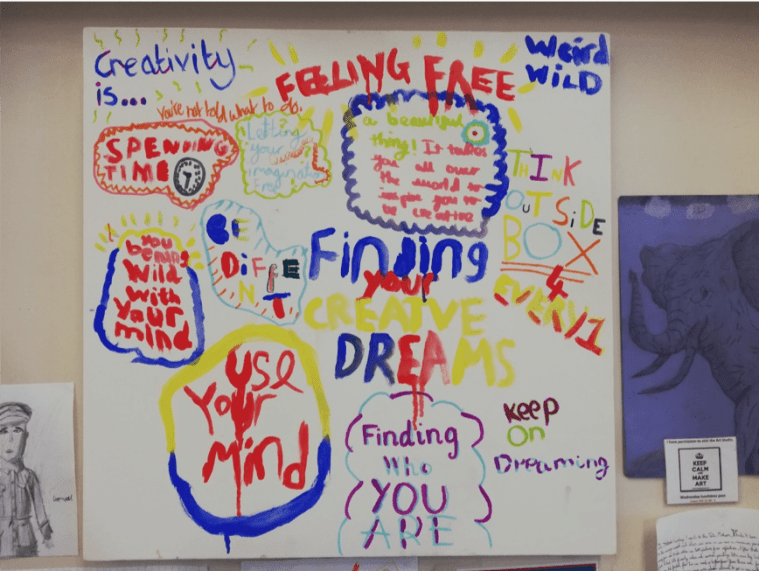
Creativity is...
Children from all years contributed to this large canvas, completing the sentence ‘creativity is…’

It is always interesting to hear the children’s responses to questions such as:

How do you know when you have made progress in art?

Why do we have art lessons?

What do you learn in art?

What are the guidelines for using sketchbooks?

How are art lessons different / the same as other lessons?

How do you improve in art?

How do you feel in art lessons?

Why do people make art?

What skills do you learn in art/ did you learn this term in art?

I don’t write in your sketchbooks, how do you feel about that?

What do you do if you are stuck in art?

Which areas do you want to improve on in art?

What makes you feel most proud in art?

Who knows the most about your progression / work in art?

These sorts of questions can really inform your choices about teaching, planning and assessment in art. I suggest very regularly collecting pupil feedback as an integral part of your art and design leadership, try to make time for it (I hear you eye-rolling at the idea of making more time to do more things? I know, sorry!).

Leading on Art has its own set of challenges compared with other primary school subjects, not least because we are often creating the intent and implementation with very little national guidance. It makes sense that our approach to its place in our schools should feel more creative, less top-down and truly consider the school community. For example, you could use a cross section of pupil feedback to create a manifesto for your art provision, feeding into your decisions around that Ofsted prompted consideration of ‘intent’.

When you are asked about progress in art and how you asses, hopefully your pupil voice evidence will backup that the methods your school uses are effective…and if they tell you otherwise, then it may be time to reflect and change. Keep in mind that Ofsted have said “developing and embedding an effective curriculum takes time, and that leaders may only be partway through the process of adopting or redeveloping a curriculum”. Be brave about evolving your art provision and changing things up a bit; as long as you have well considered reasons….pupil voice can form a big part of that story.


Teaching Art but don’t feel ‘Arty’ or creative?

I love all the work I do with primary school teachers and I have the utmost respect for them. Having really only ever taught Art and Design at primary (and secondary) myself, I am always in awe of how class teachers navigate their way through all the subjects, not to mention all their other tasks and responsibilities.

Teaching at primary level, more so than secondary, involves a fair amount of teacher self-led learning and re-familiarising with subject knowledge and skills. What we, in schools think of as ‘planning time’ does not necessarily factor this in; for that is time set aside for you to plan and resource the lessons for the children, assuming you have the skills and knowledge to hand (or, that a cursory recap will suffice). I always think that it is just as valid if you need to spend that time reading a few wiki pages or practicing some skills, maybe this should have another title…self directed CPD perhaps?!

Most teachers feel more confident and comfortable teaching some subjects over others and that is totally natural and understandable, we all come to teaching with a different set of experiences and preferences. The only problem is that this this bias towards certain subjects inevitably has an impact on how the children experience different subjects.

I have heard many teachers and teaching assistants say things like ‘oh no, I hated art at school’ or ‘I am just not creative at all’ and frequently ‘I can’t draw’. I strongly advise against using that sort of language in front of the children, as much as we wouldn’t expect a teacher to share how much they hate maths at the start of a maths lesson. I think it is fine and even helpful to share with the children when we find something challenging though, because that is a common human experience, and to share models a willingness to learn and grow.

I invite primary teachers who have to teach, or even lead on, Art and Design (I know you didn’t necessarily ask for that responsibility) to reflect back on their own experiences of primary or secondary art lessons. Do this with a view to reconnecting with why and how you feel the way you do when you have to teach or lead on the subject. Some primary teachers I meet have not made any art themselves since year 9, some were told they were not good enough at primary school, some were teased by others about their art…there are so many ways that seemingly small or insignificant experiences can knock our confidence. If we leave those moments unvisited we run the risk of negatively impacting the creative or artistic experience for those we teach.

Drawing, painting etc. are skills that can be broken down and taught or learned, they are not exclusive gifts for some people. Likewise, talking about art or analysing art can be accessed by googling ‘how to talk about art?’ – I like these Aesthetic Scanning guidelines by Harry S. Broudy in “The Role of Imagery in Learning”. Given the time, any teacher can get to grips with making art and talking about art.

That brings me to creativity; it is worth remembering that this is something already valued by employees and predictions say it will be increasingly desirable in future workplaces. It is a soft skill that may not be so easily nurtured in AI or technologies and I believe it is something we are born with. Getting into a creative task can utilise your sense of resilience, problem solving and a whole host of other skills. Not to mention that being in a state of creative flow feels good and promotes wellbeing.

Your creative outlet might be baking, playing an instrument, sewing, creative thoughts as you walk your dog, interior design or how you dress in the morning. Creativity is in all of us.

One of my favourite parts of delivering training and running workshops with children and adults, is seeing people get back in touch with their own sense of creativity. It is (sorry to be cheesy) a really beautiful thing.

I hope you, as a teacher, have some moments of creative flow in your days – however that may look for you. Your children will benefit from your genuine understanding of how important and nice-feeling those magic moments are.

Get in touch if you’d like to speak about how I can help you with your primary art provision, and/or support your staff in feeling creatively empowered and ready to teach.

IMG_20191030_191047_210
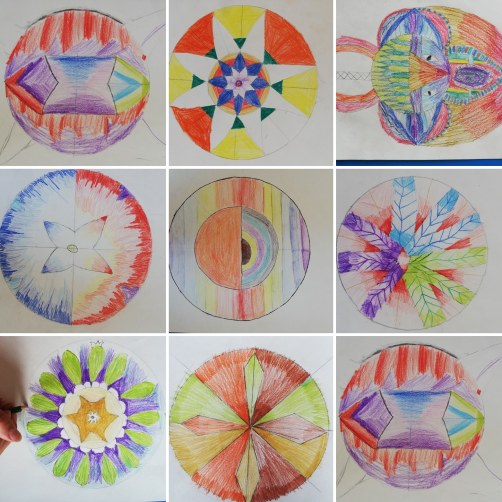
Mandala designs by year 4